E2 · Consortium vs single bank
43.8%
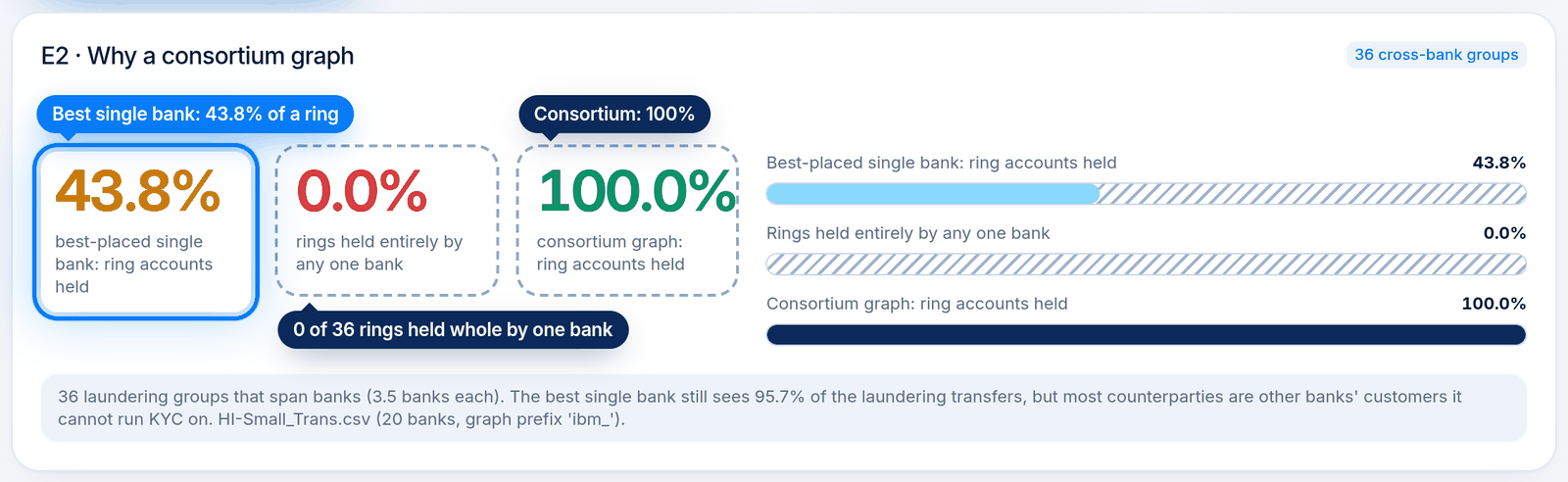
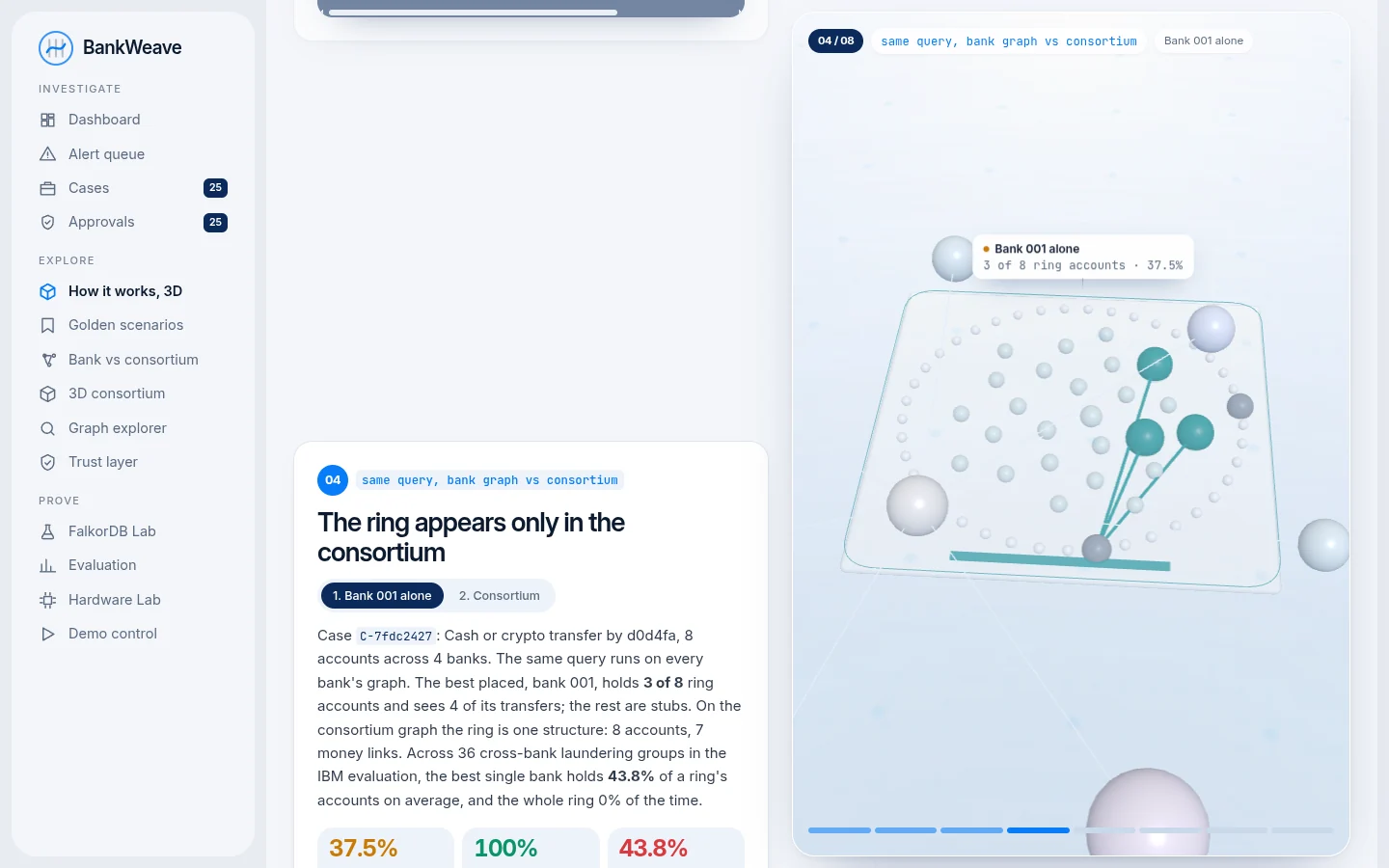
The best-placed single bank holds 43.8% of a ring's accounts on average and holds none of the 36 cross-bank rings whole. The consortium graph holds all of them.
Scroll sideways, or tap for the full-size capture.
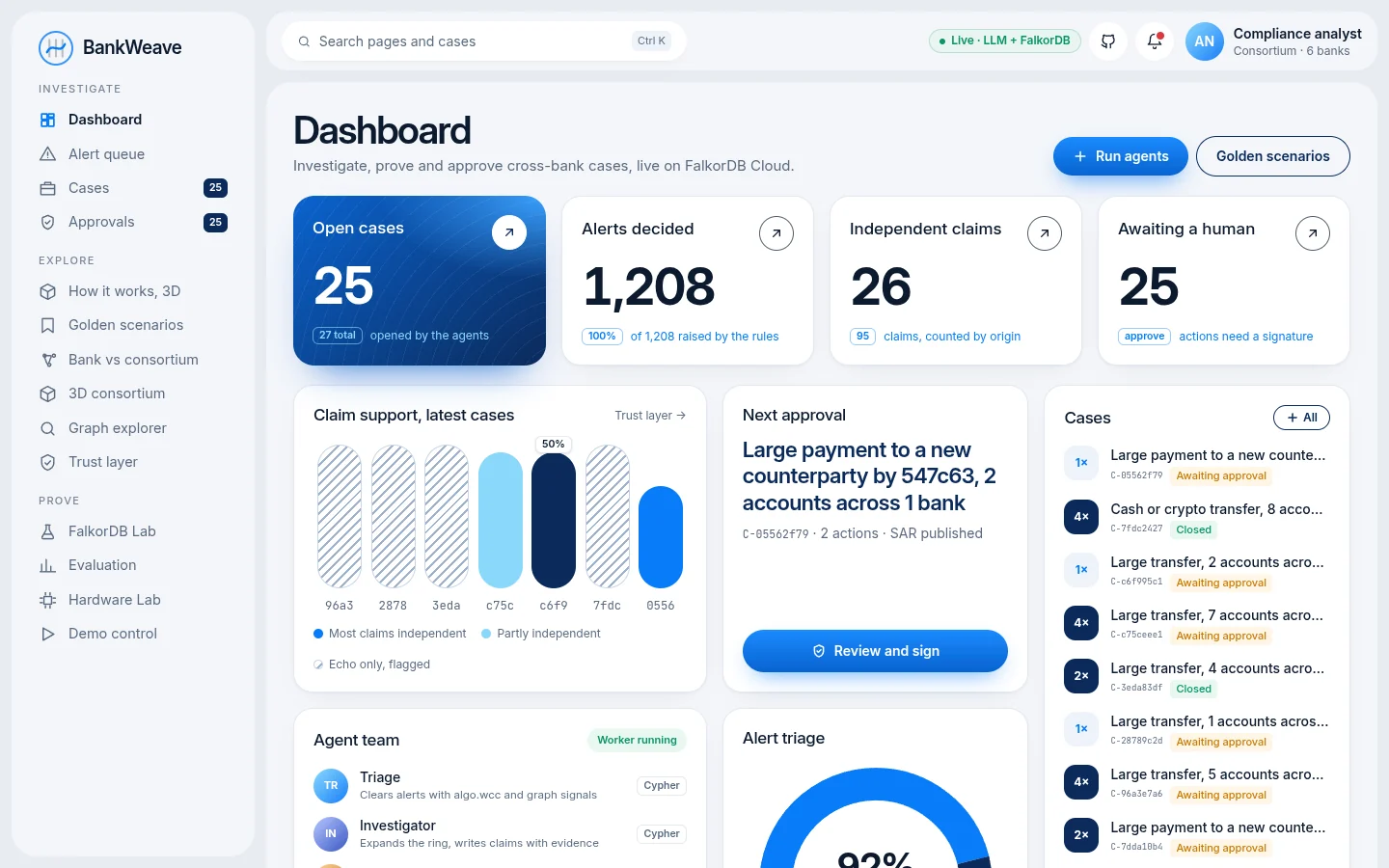
AI agents investigate alerts across banks in one FalkorDB instance. Each bank keeps its own graph, rings appear where the graphs join, and every sentence of a report points to the query that proves it.
alerts decided by agents
independent claims
live overview query

Built on
The demo
The problem, the idea on a whiteboard, then the live product on FalkorDB Cloud: agents, the ring reveal, a case, the hardware edge, MCP and FalkorDB's own browser.
Narrated, captions burned in. Every screen is the live site; every number comes from the product or eval/results.
Why a consortium graph
What's new in v3
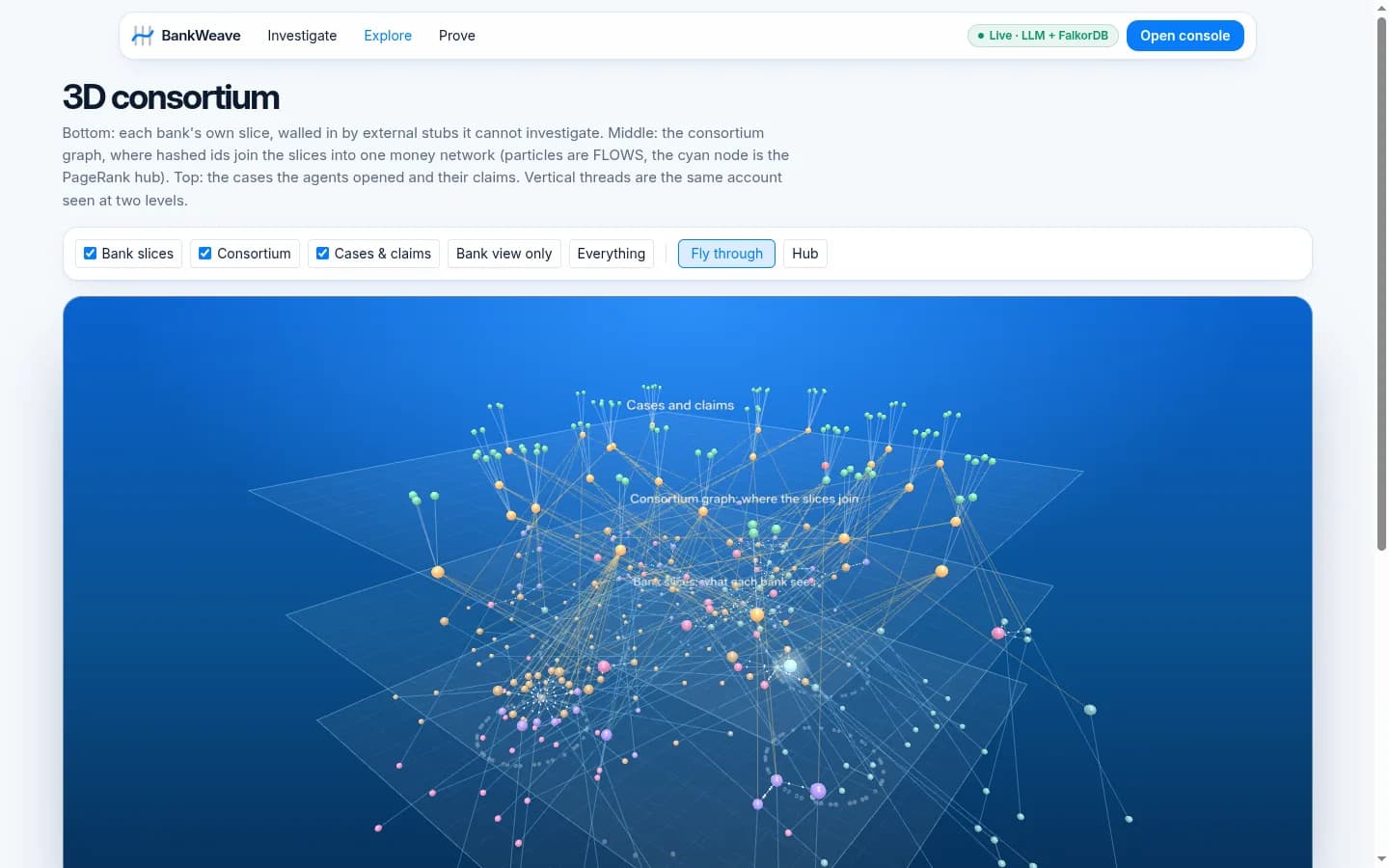
A Cypher explorer over every graph, a 3D walkthrough where each scene is one FalkorDB call, a live dashboard and an MCP server you can add to Claude.
Graph explorer
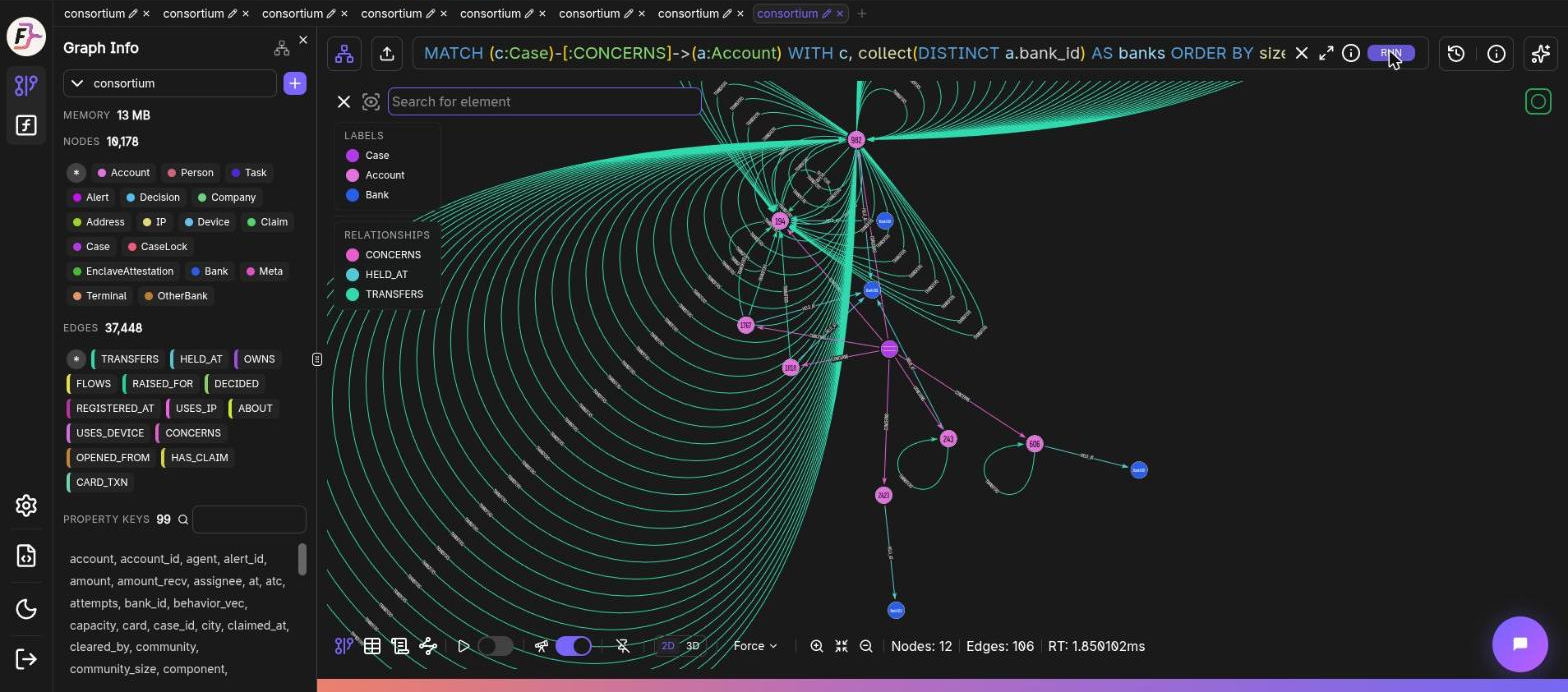
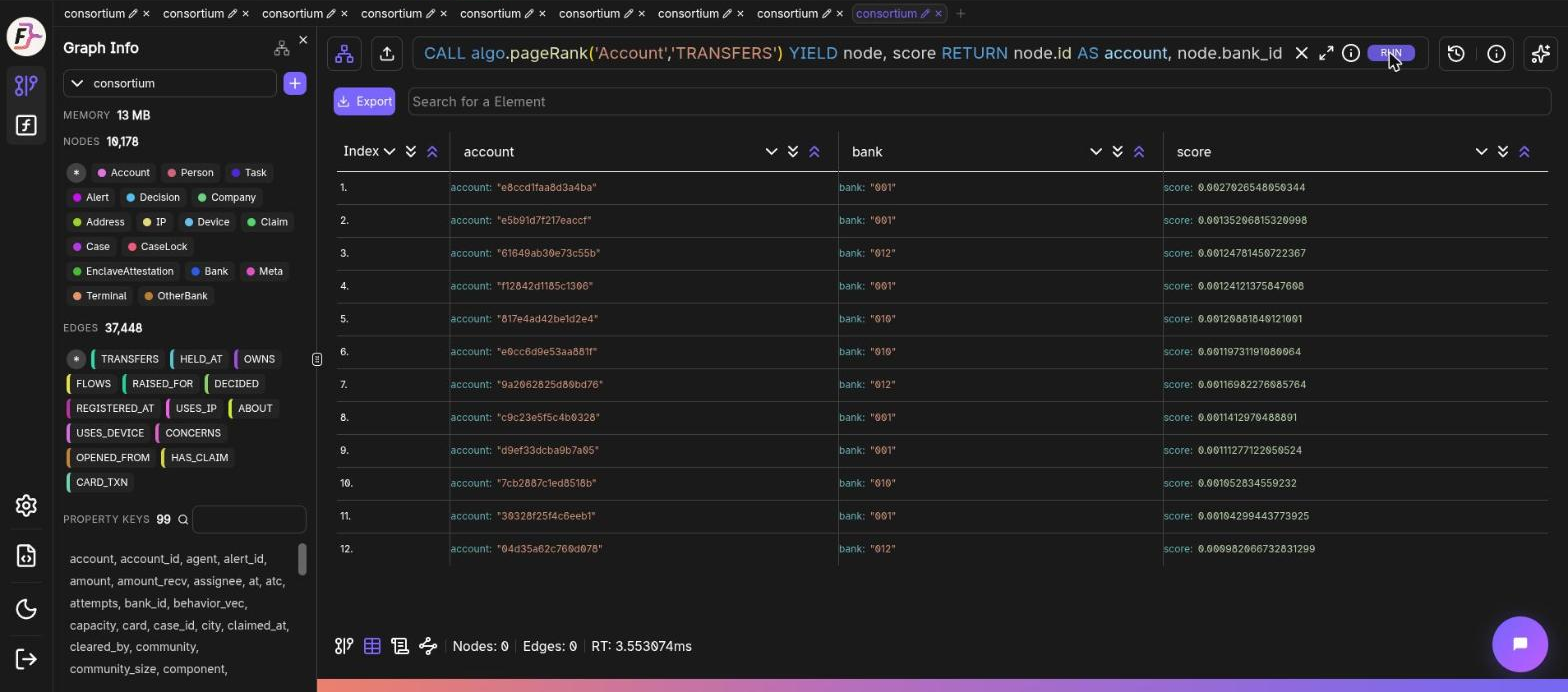
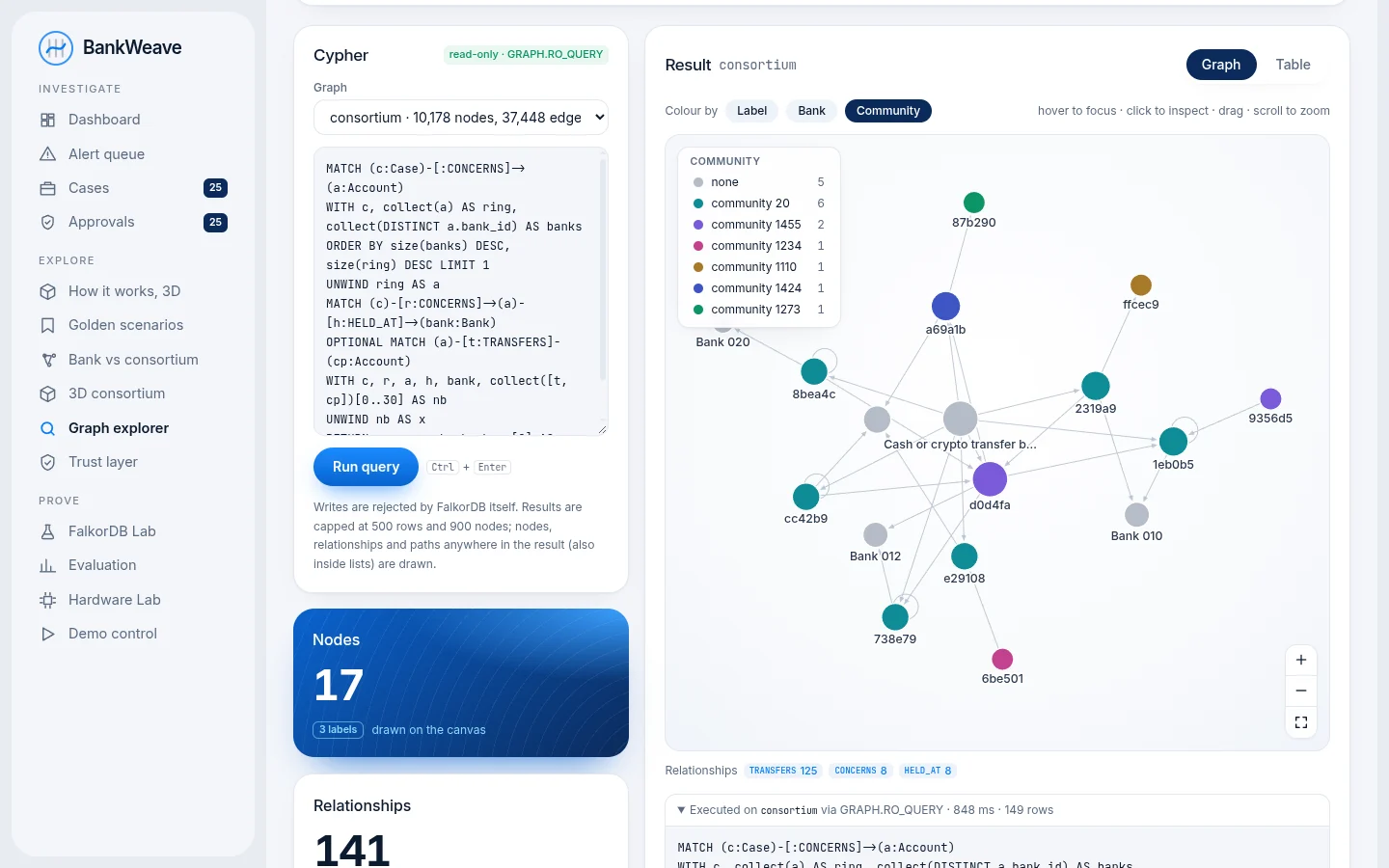
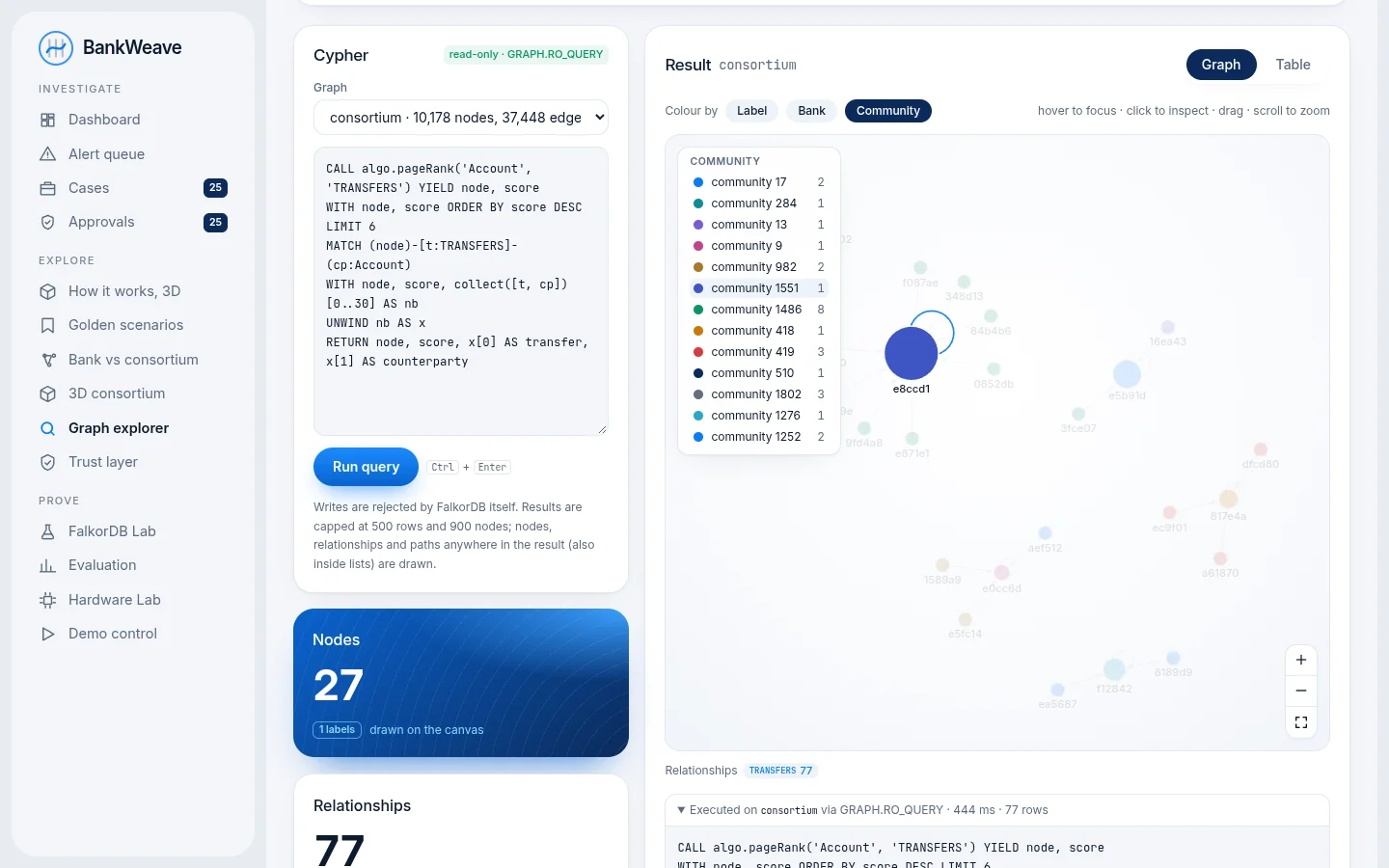
Twelve presets run live against FalkorDB Cloud: a cross-bank ring laid out by bank, algo.pageRank over the consortium, shared devices. Edit the query and run your own.
Open /explorer
3D explainer
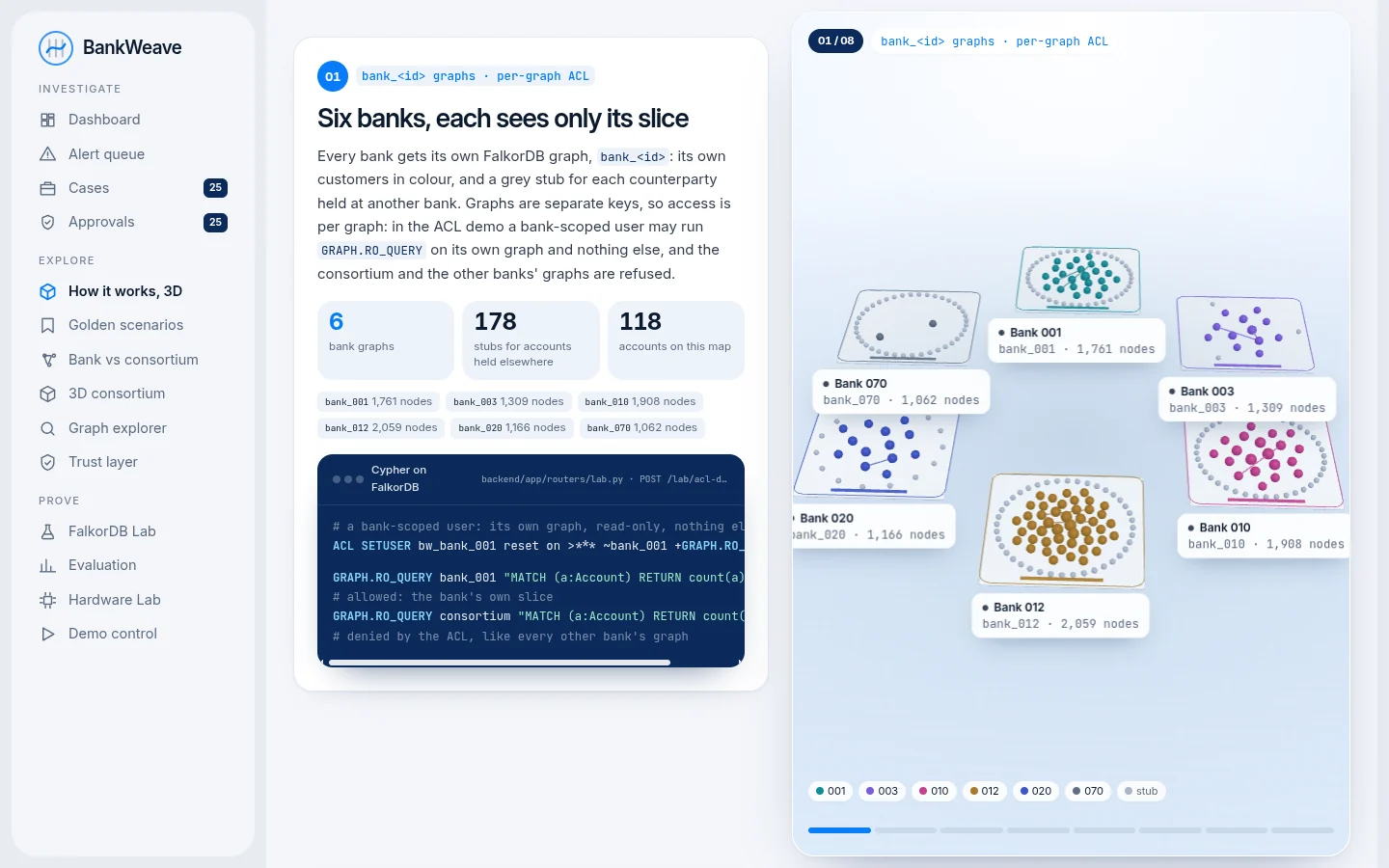
Six bank graphs, the consortium joining them and the ring that only appears there. Each scene is one FalkorDB call you can read.
Open /explainer
Dashboard
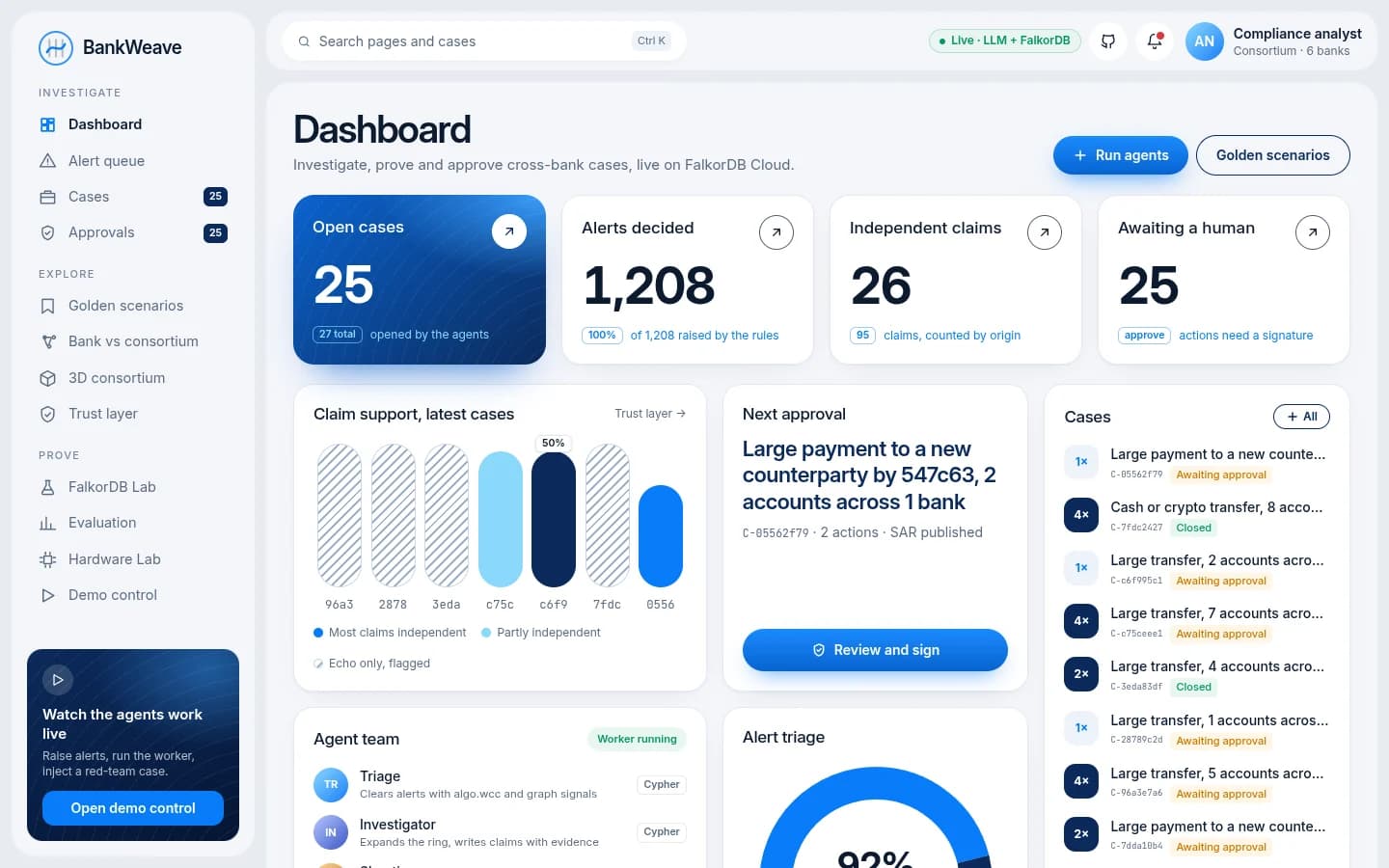
Alert queue, open cases, approvals waiting for a signature, FalkorDB health and what each agent is doing, refreshed from the live API.
Open /command
Hosted MCP
One line adds BankWeave to Claude. No install, no key: the server is the live API, read-only, with 3 prompts and 2 resources besides the tools.
Read docs/MCP.md$ claude mcp add --transport http bankweave https://bankweave-api.onrender.com/mcp# 17 read-only tools; each one returns the Cypher it ran
# and 9 more: list_graphs, graph_schema, list_cases, account_network, …
Each bank's transfers live in its own FalkorDB graph with its own ACL. The consortium links accounts by blinded ids.
Open it live →36Ten paths to one shared device count once. Confidence is computed over independent origins.
Open it live →Overturn one fact and every claim, action and sentence resting on it is flagged in one traversal.
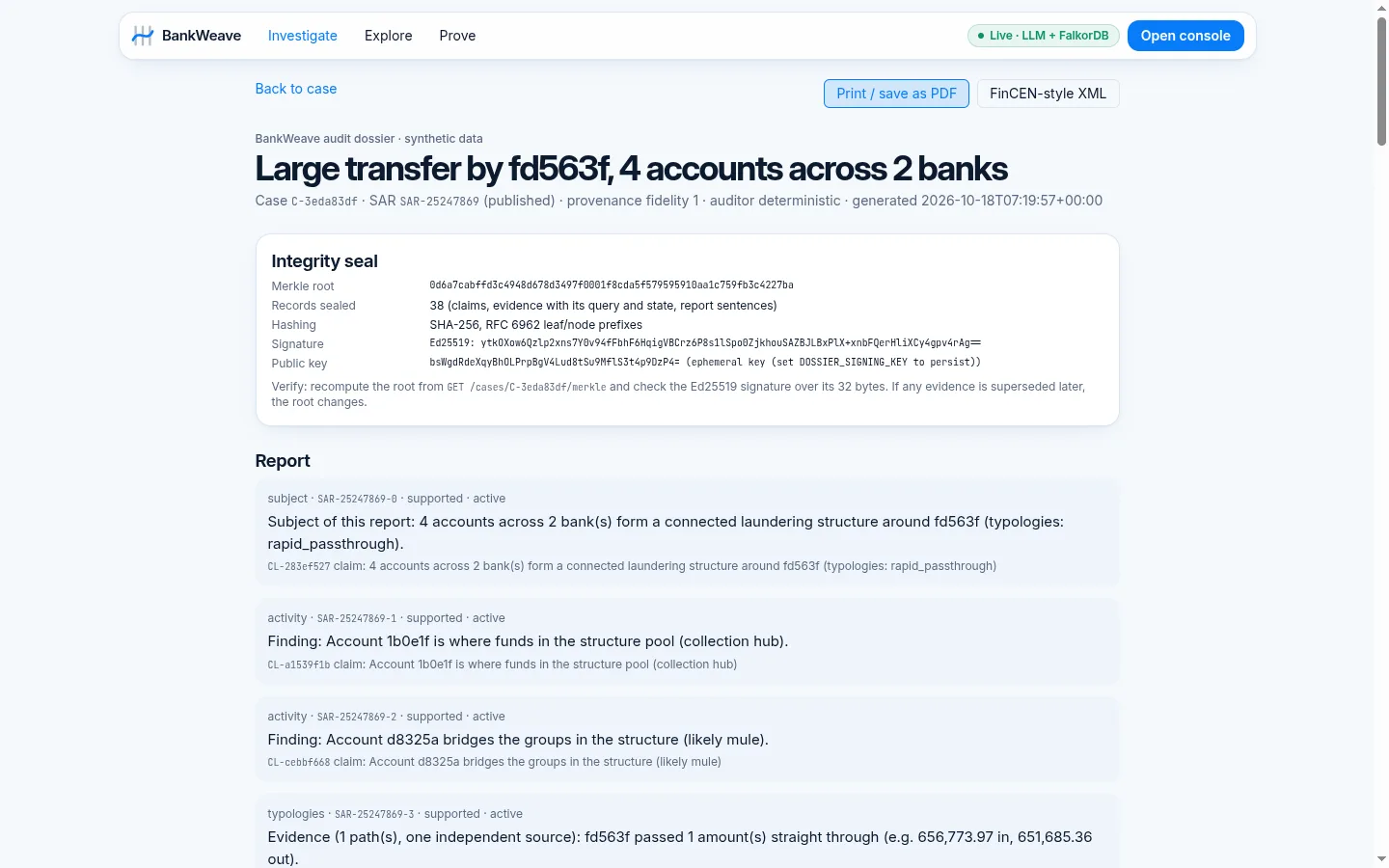
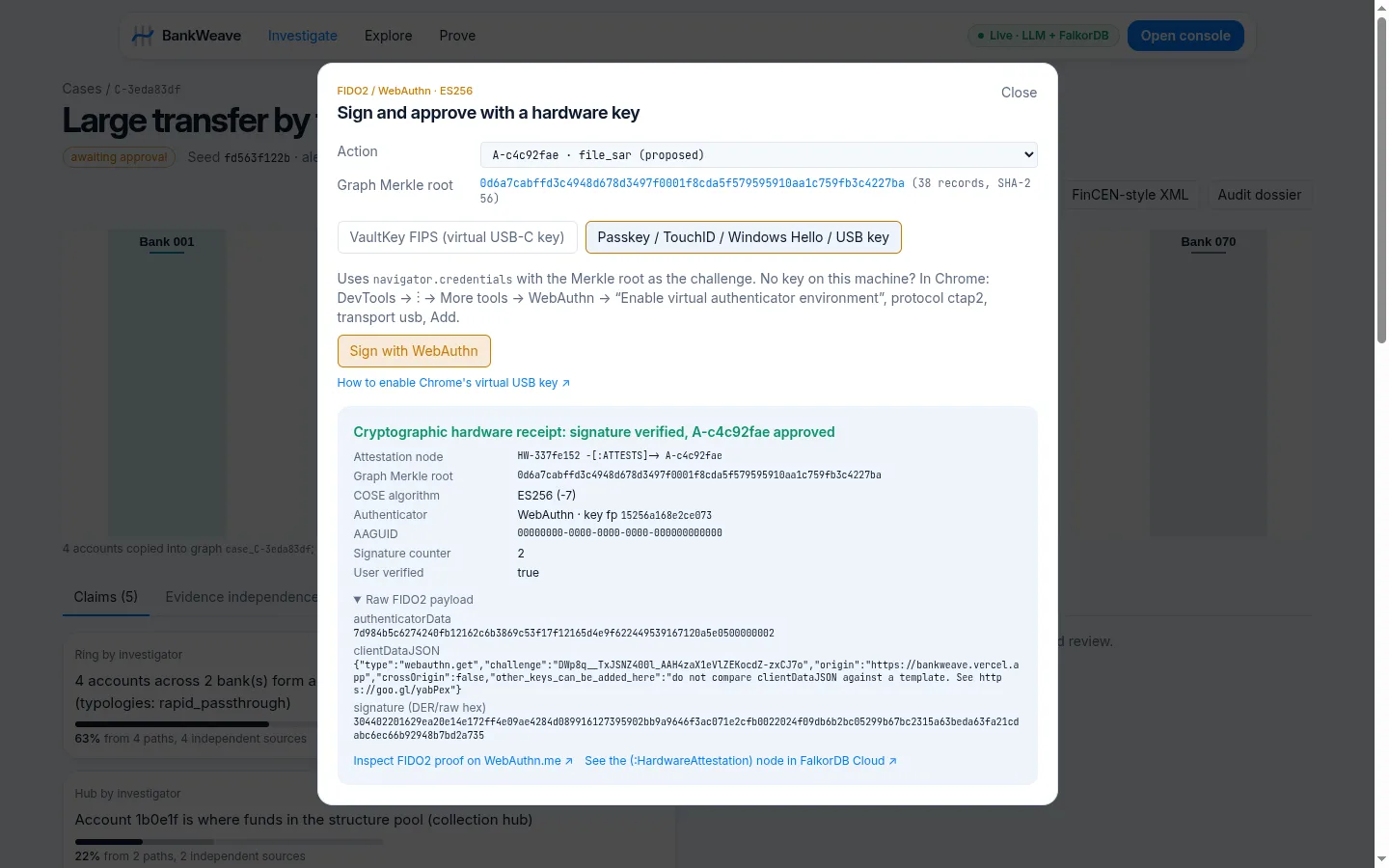
Open it live →Approvals are WebAuthn signatures over the case's Merkle root. Change any evidence and the seal breaks.
Open it live →Measured on IBM's laundering data
Screenshots of the live Evaluation page; every figure comes from eval/results in the repo.
E2 · Consortium vs single bank
43.8%
The best-placed single bank holds 43.8% of a ring's accounts on average and holds none of the 36 cross-bank rings whole. The consortium graph holds all of them.
Scroll sideways, or tap for the full-size capture.
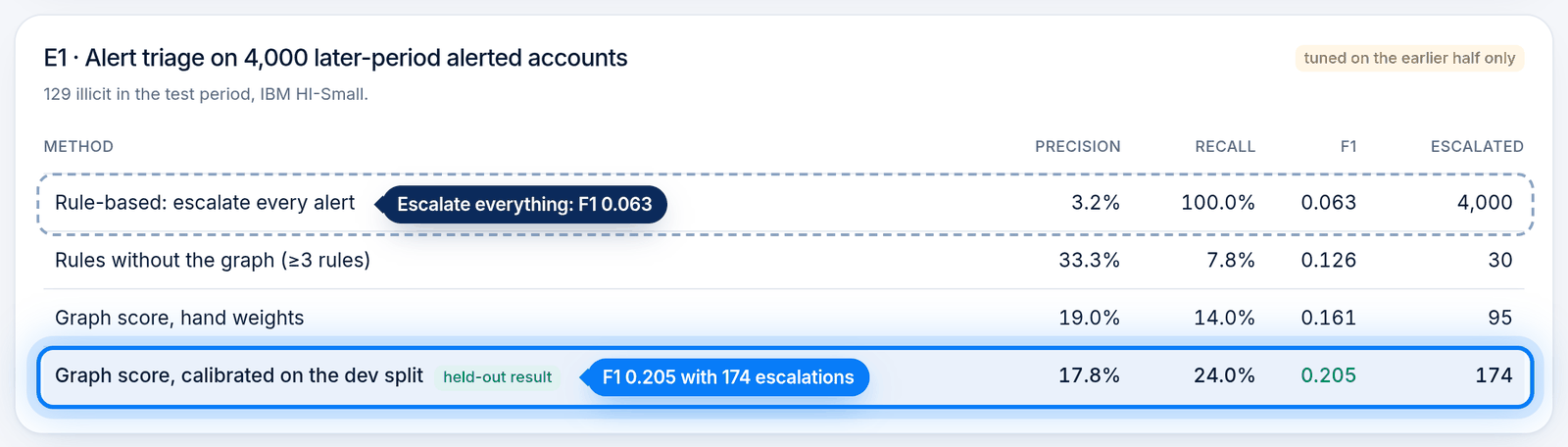
E1 · Alert triage, held out
0.205
On 4,000 later-period alerted accounts, the calibrated graph score reaches F1 0.205 while escalating 174. Escalating every alert scores 0.063.
Scroll sideways, or tap for the full-size capture.
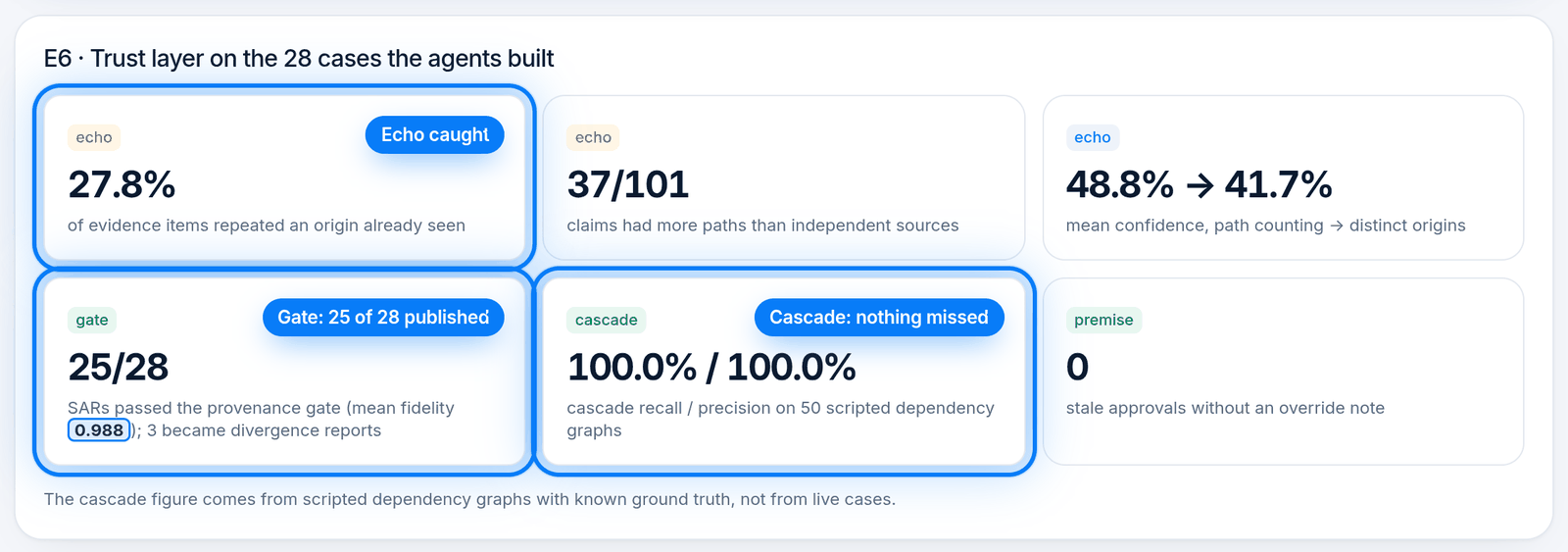
E6 · Trust layer, 28 agent cases
27.8%
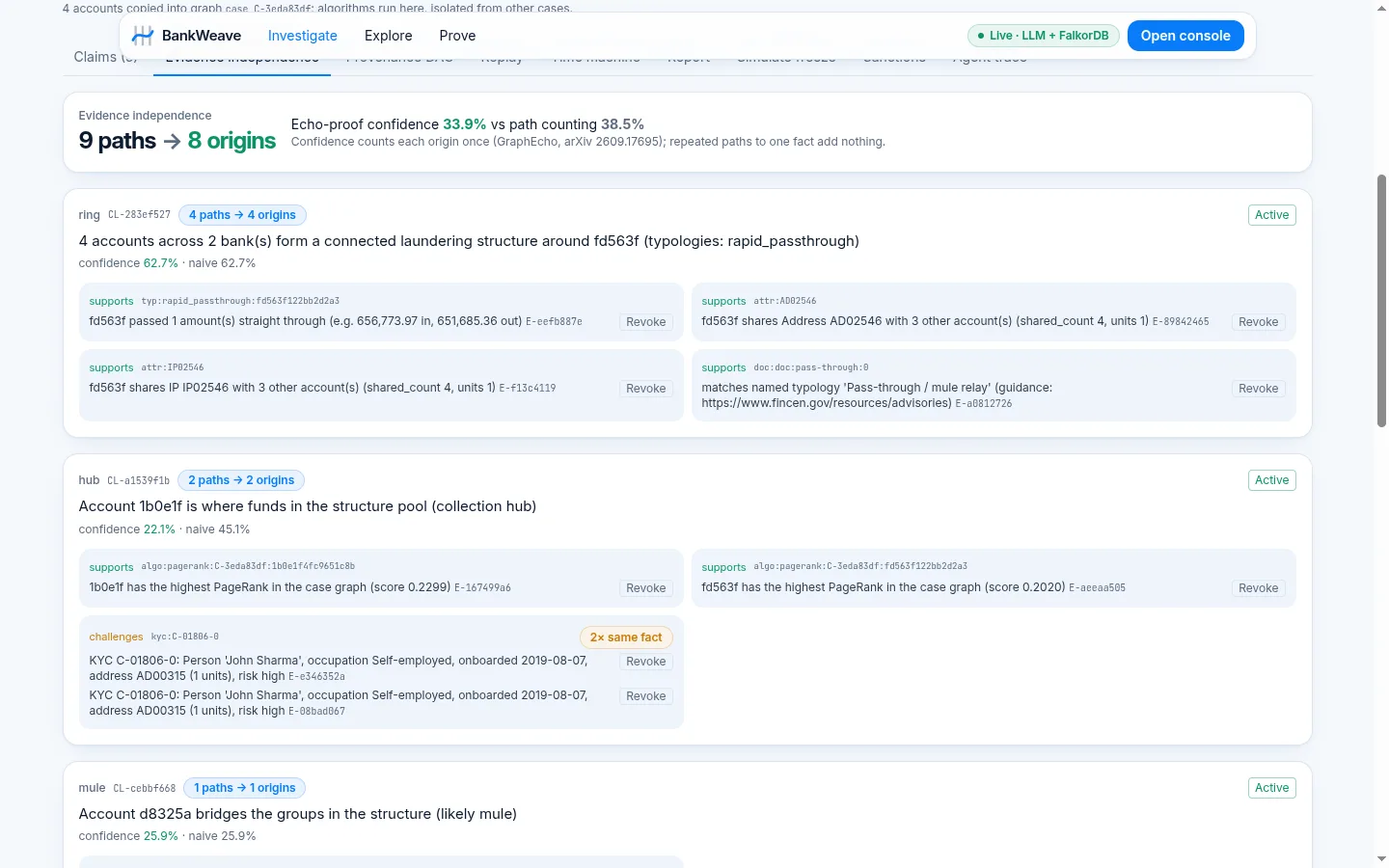
27.8% of evidence items repeated an origin already counted. 25 of 28 reports passed the provenance gate at mean fidelity 0.988, and cascading invalidation found every affected item.
Scroll sideways, or tap for the full-size capture.
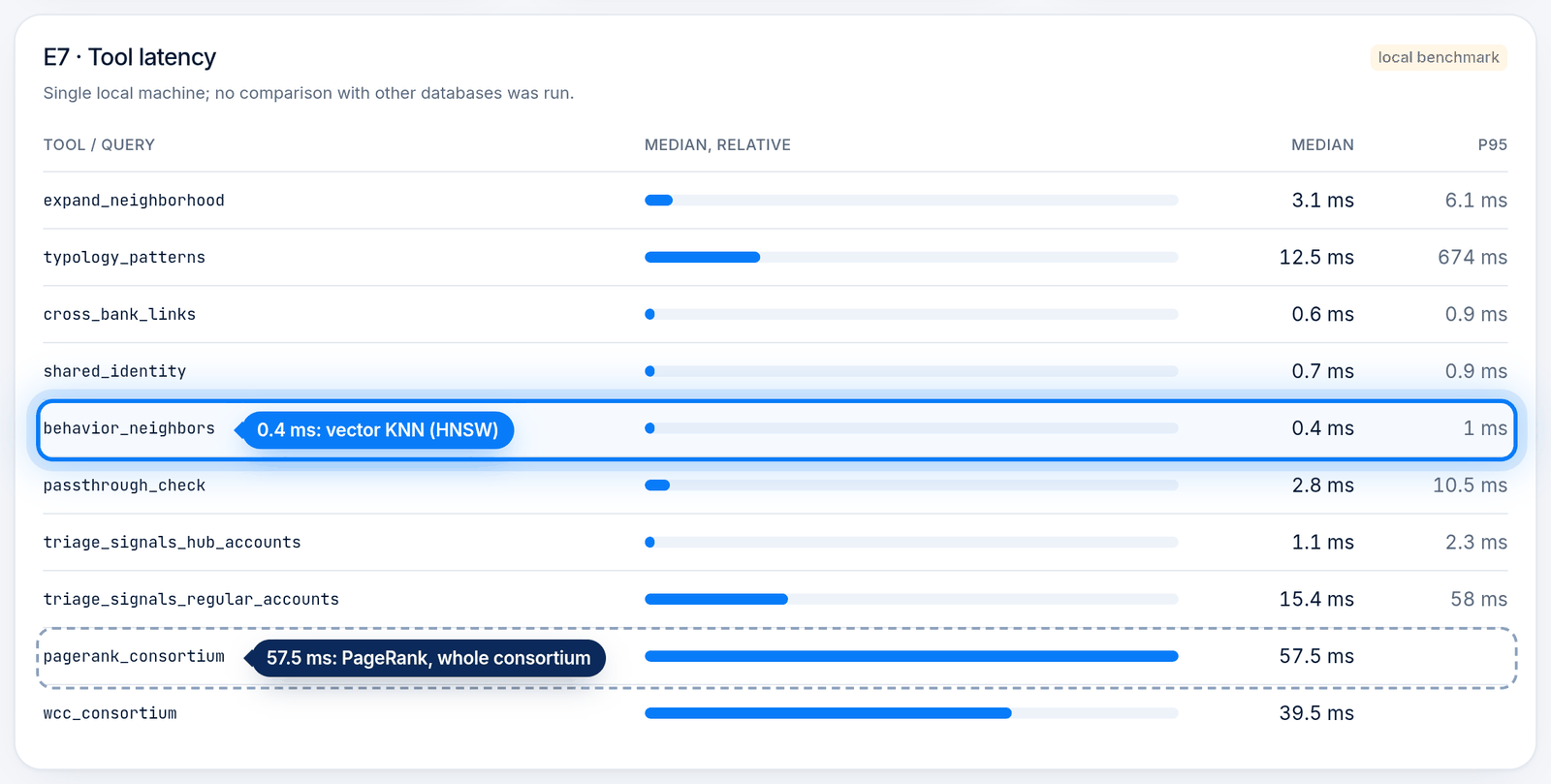
E7 · Tool latency, 1.3M transfers
0.4 ms
Median tool latency on one machine over 1.3M transfers: 0.4 ms for vector neighbours, 57.5 ms for PageRank across the whole consortium.
Scroll sideways, or tap for the full-size capture.
27.8%
of evidence items repeated an origin already counted
E6 · echo
25 / 28
SARs passed the provenance gate
E6 · gate
0.988
mean provenance fidelity
E6 · gate
100%
recall on cascading invalidation, 50 scripted graphs
E6 · cascade
Misses are reported there too, such as E3, a paper reproduction that did not hold on this data.
Inside a case
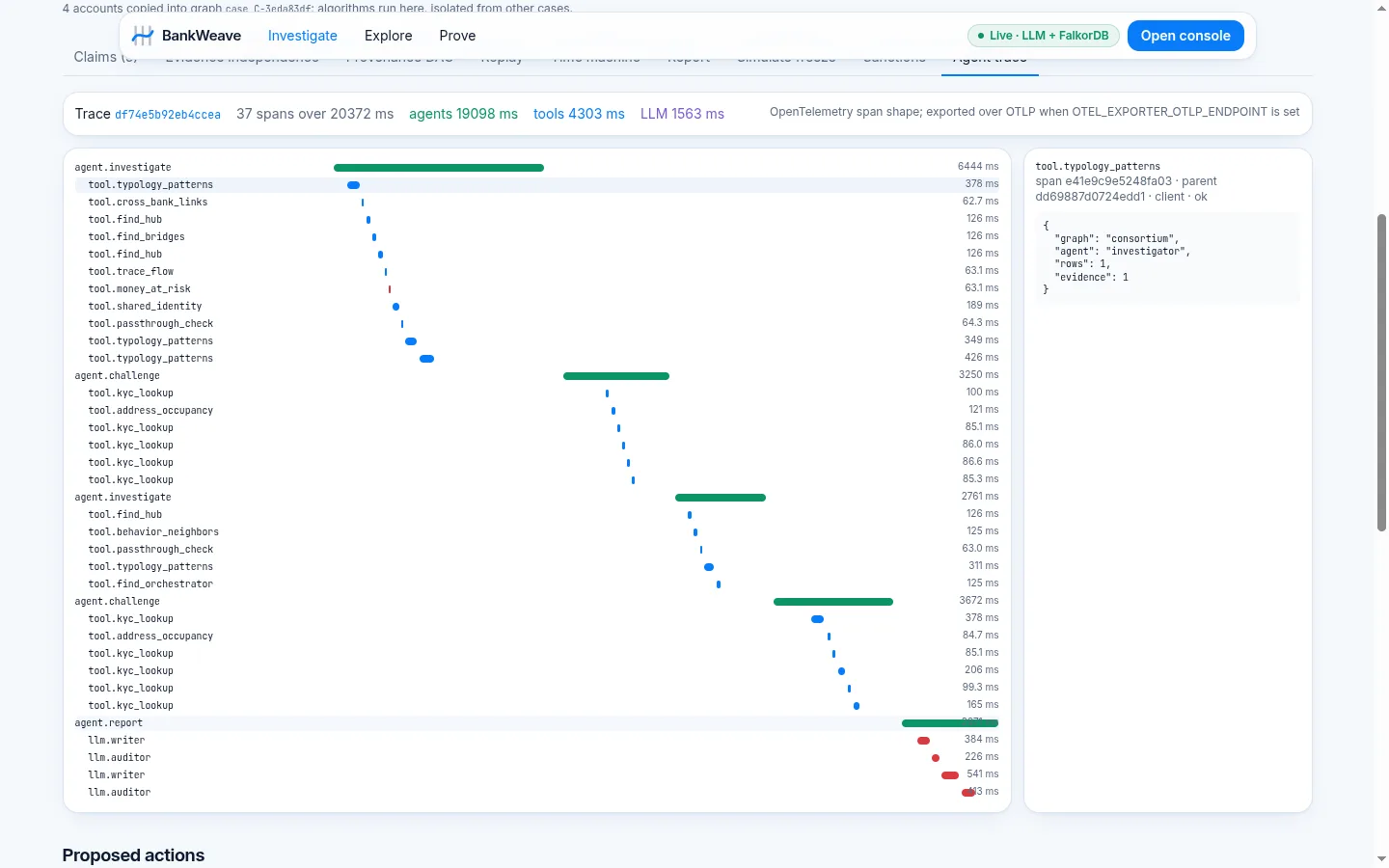
Screens from the live site, running on FalkorDB Cloud with the agents on Groq.

Ten paths to one shared device are one fact. Confidence is computed over independent origins, not paths.
See it live →Not a mock-up
Screen recordings on third-party sites. The terminal and the ESP32 are simulations; the HTTPS call, the graph write and the TLV are real.

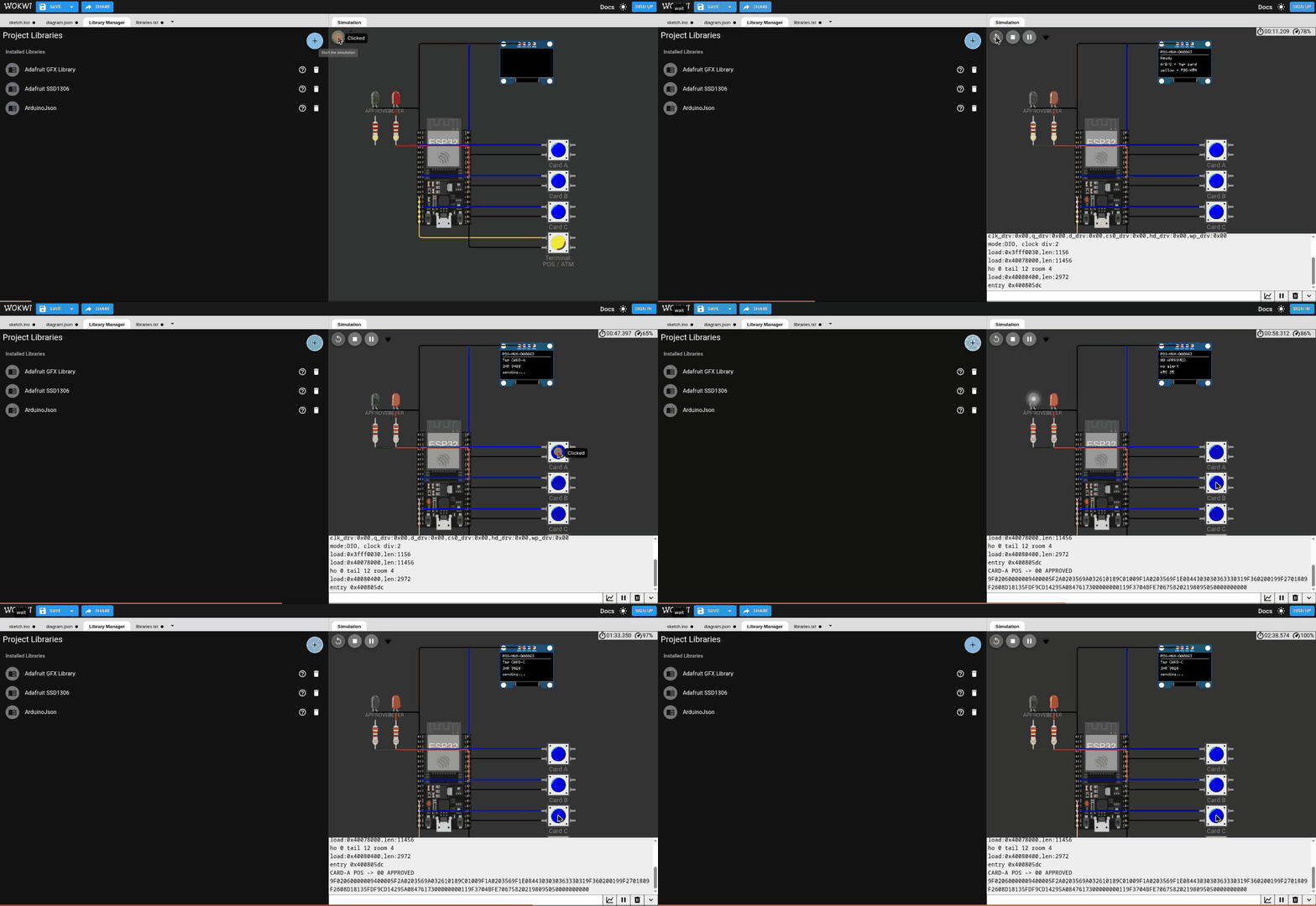
The sketch posts a card tap over HTTPS to the live API, which answers 00 APPROVED, writes the CARD_TXN edge into FalkorDB Cloud and returns ISO 8583 field 55 to the serial monitor.

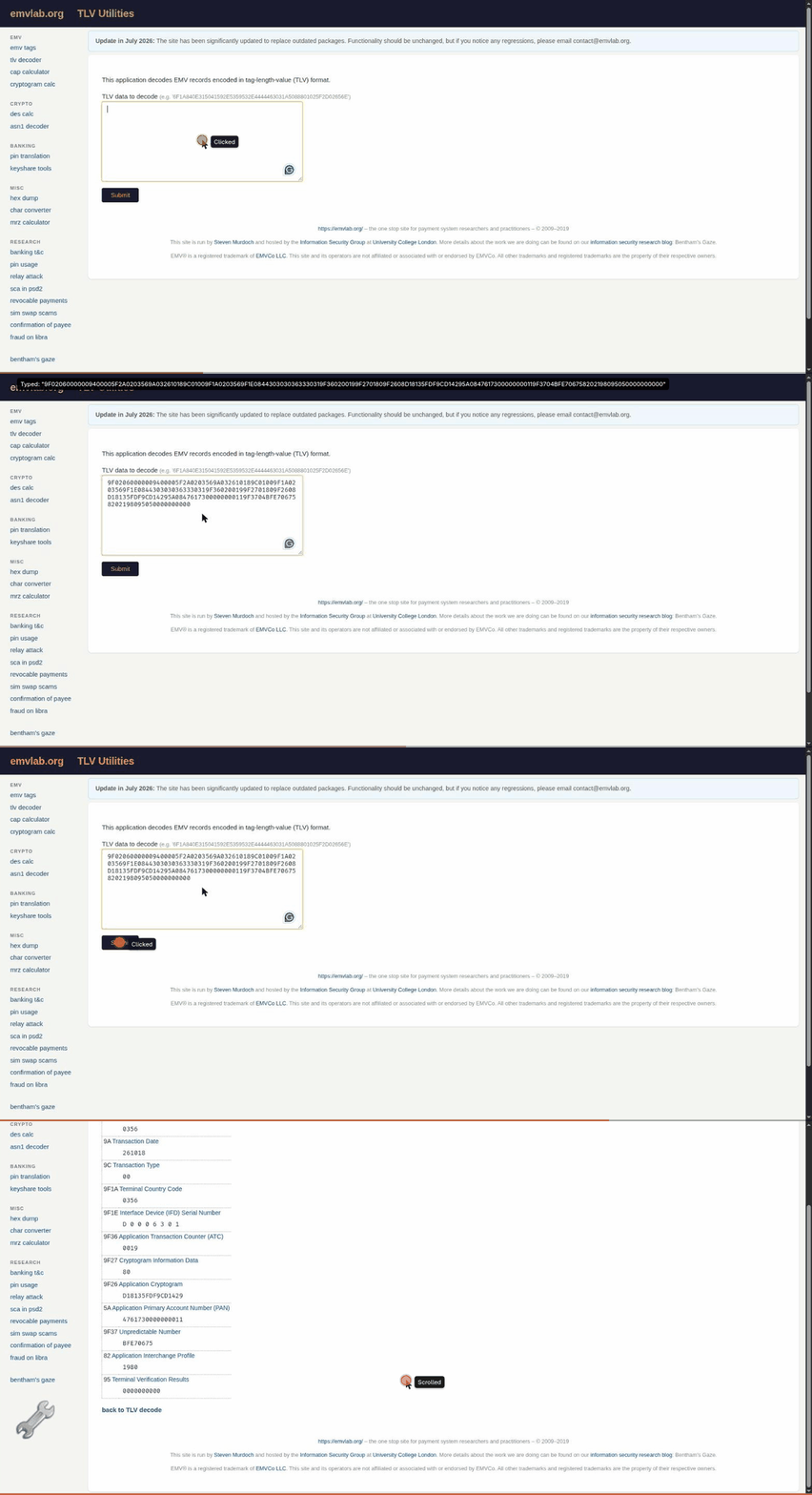
The field 55 printed by the board, pasted into EMVLab.org's decoder: amount, currency, IFD serial, transaction counter and cryptogram all parse.

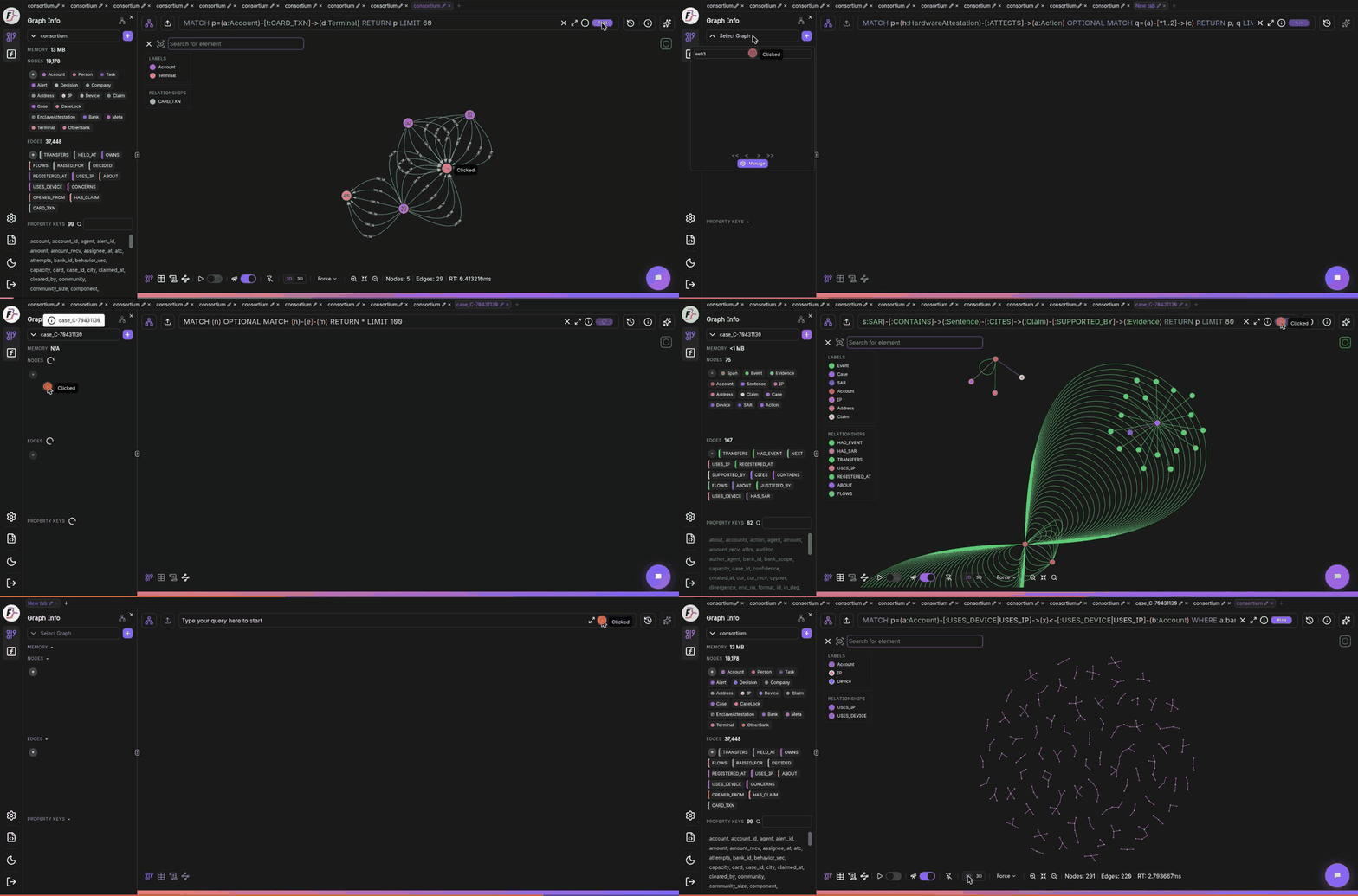
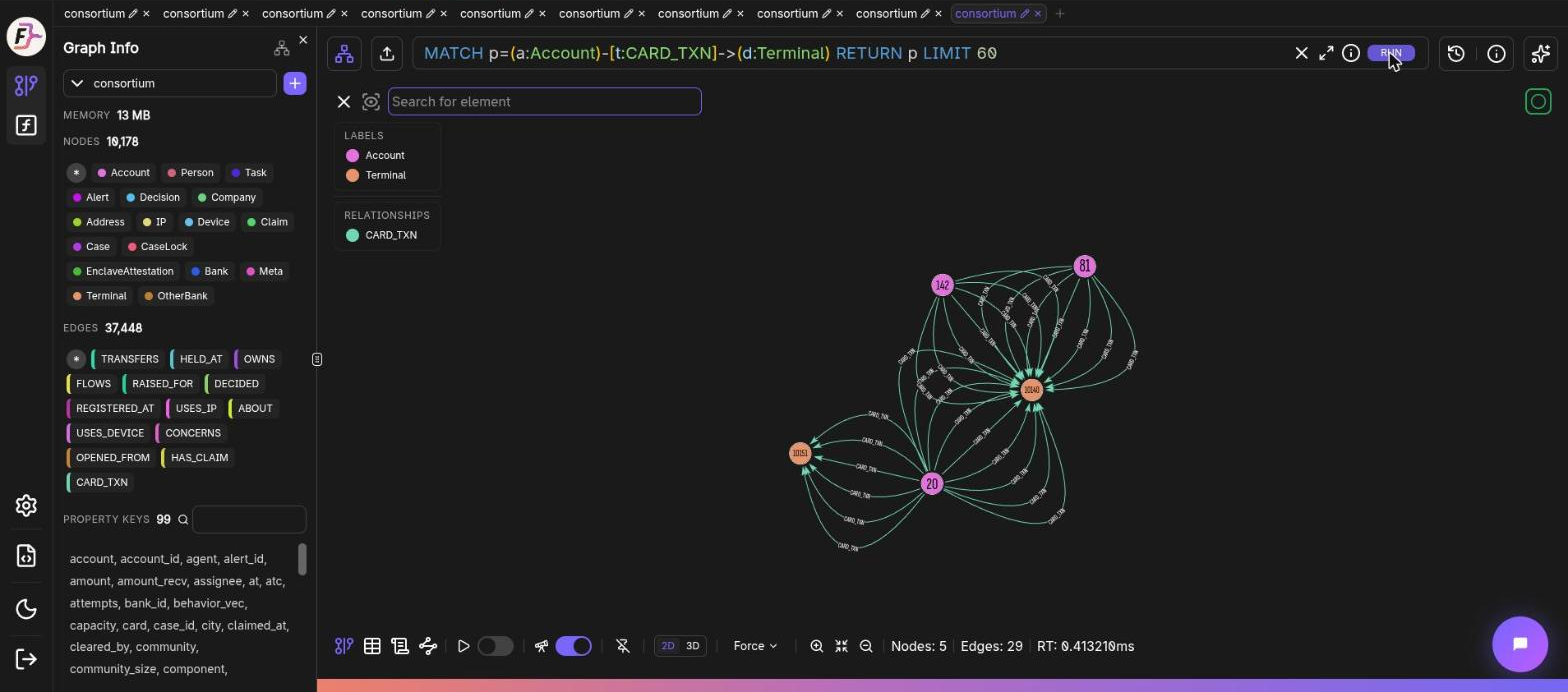
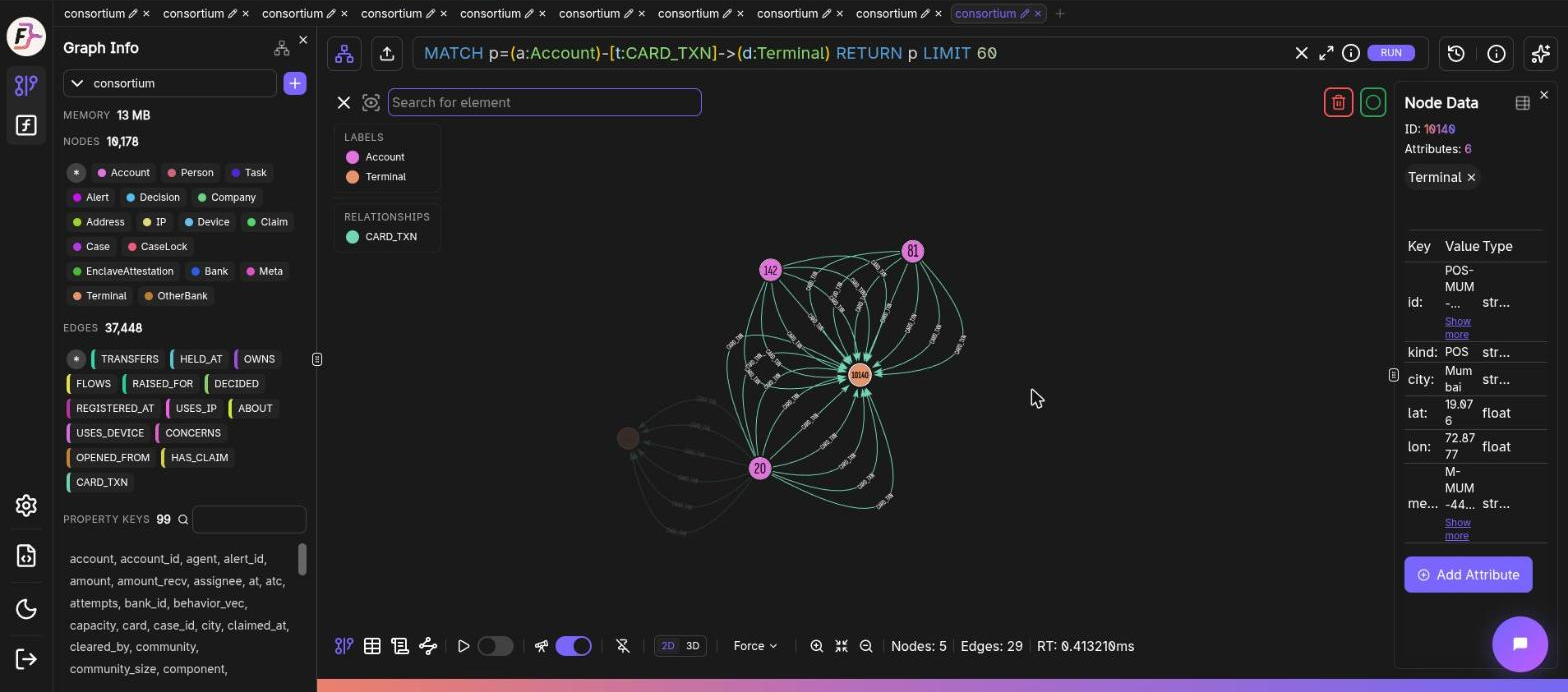
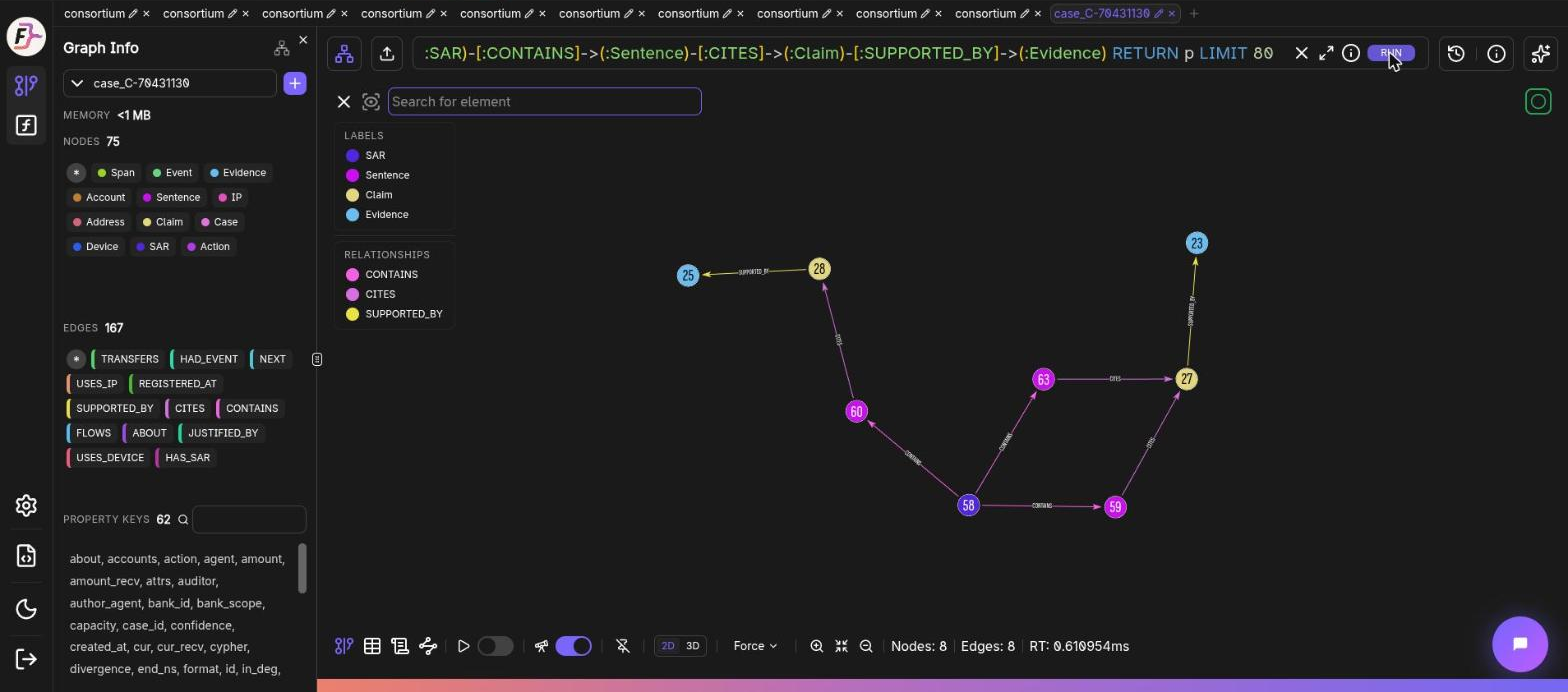
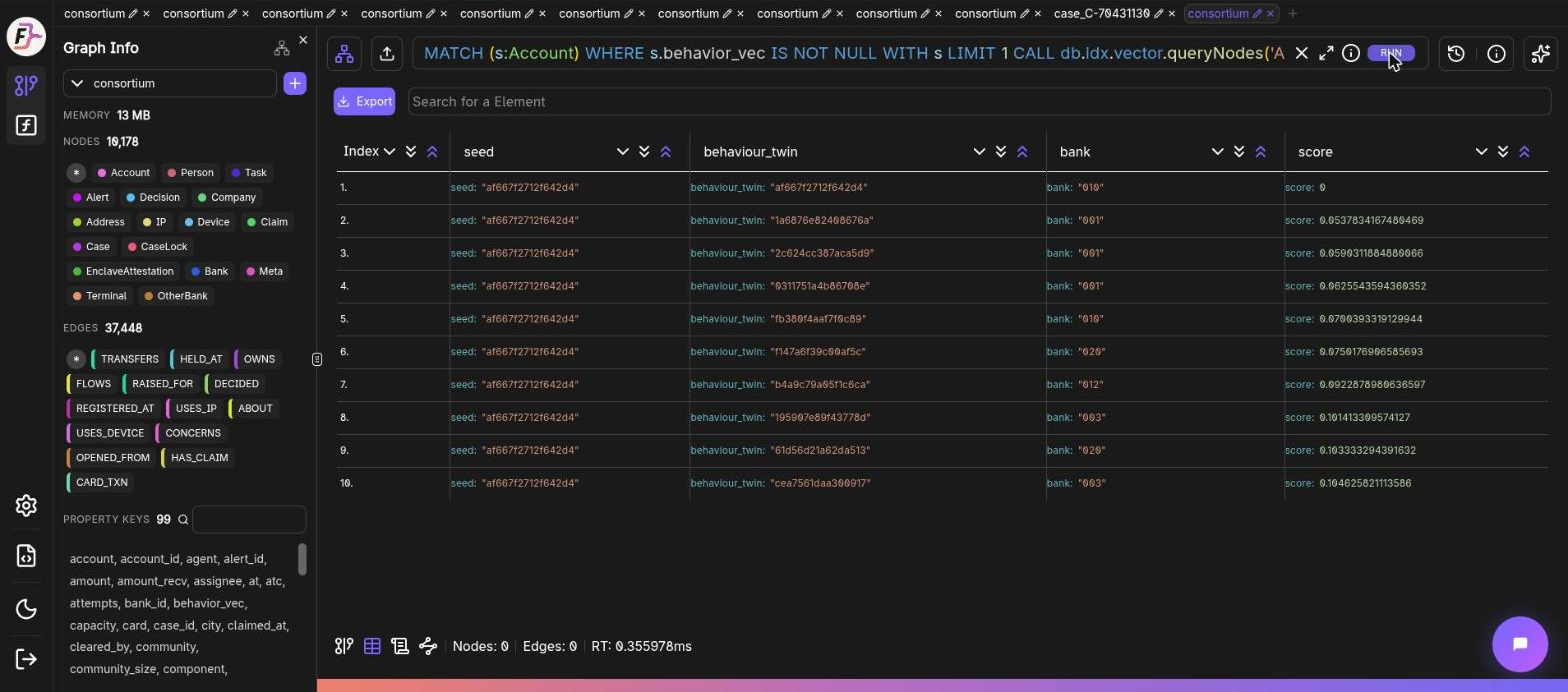
The cross-bank ring, algo.pageRank, the card-tap edges, a SAR's provenance chain and vector KNN, typed in as read-only queries. The hostname bar is cropped.

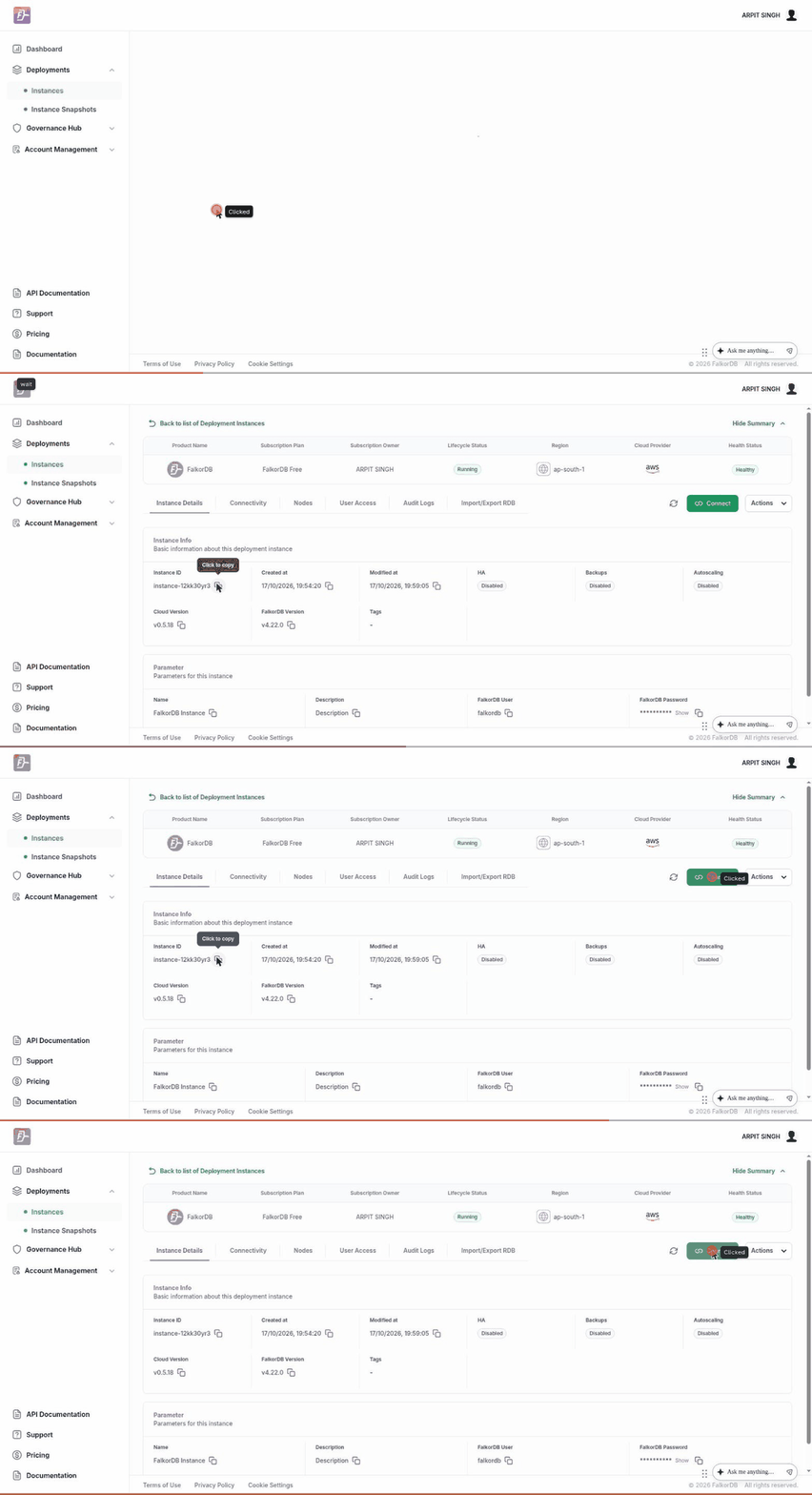
The instance the live site runs on: Free tier, ap-south-1, FalkorDB v4.22.0, status healthy.
Try the terminals and the security key on the Hardware Lab.
FalkorDB Browser
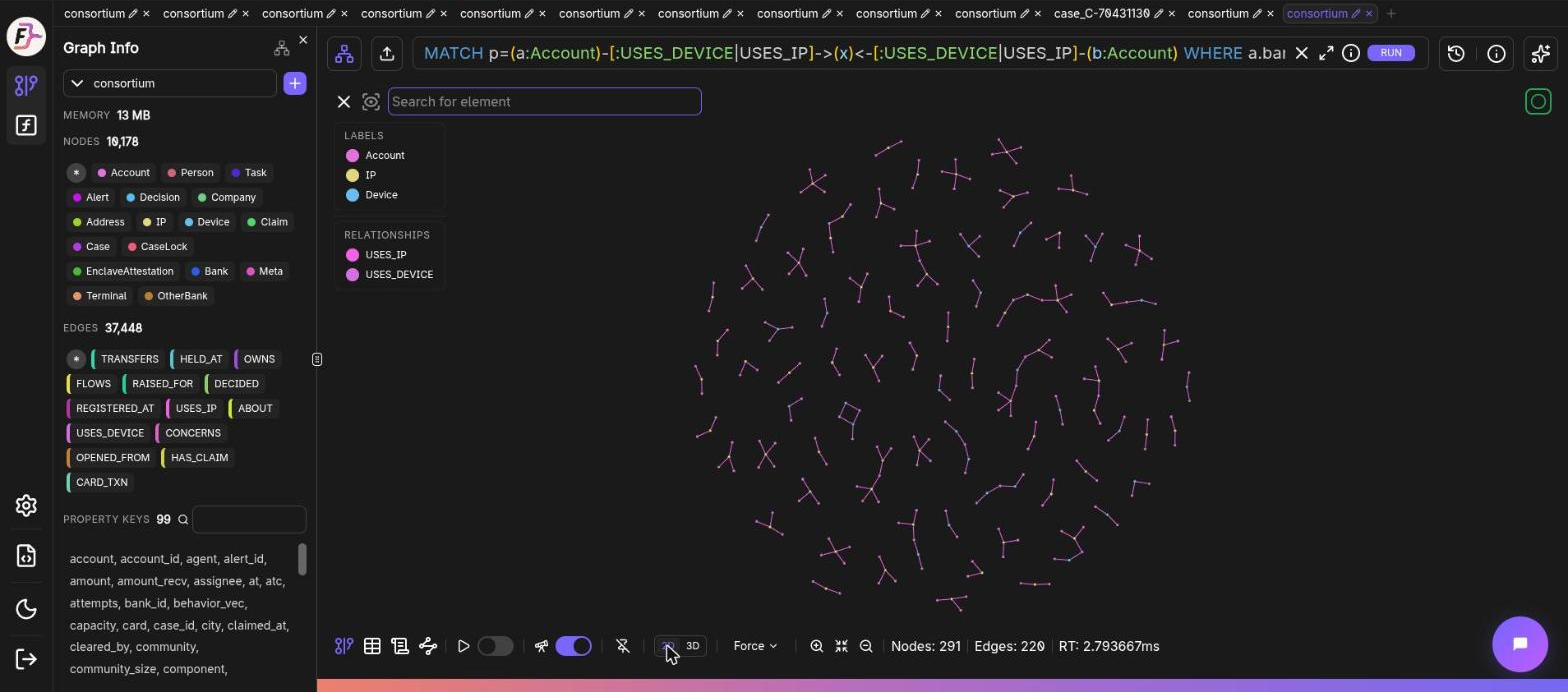
The graphs the agents use, queried in browser.falkordb.com against our Cloud instance (v4.22, 36 graphs). Timings are the engine's own readout.

12 nodes, 166 edges

native GraphBLAS

29 CARD_TXN edges

with its GPS, 19.076, 72.8777

the provenance gate as a pattern

behaviour twins at five banks

291 nodes, 220 edges
How it works
LLMs plan and write. Cypher and FalkorDB's algorithms compute. A human approves every action.
Agents opening cases on FalkorDB Cloud right now, with every claim one click from the query that proves it.